



11 Aug LED Apron Lighting Built to Survive a Category 5 Hurricane
Category 5 Hurricane-Rated · Phased Apron Lighting · 10-Year Zero-Maintenance Warranty
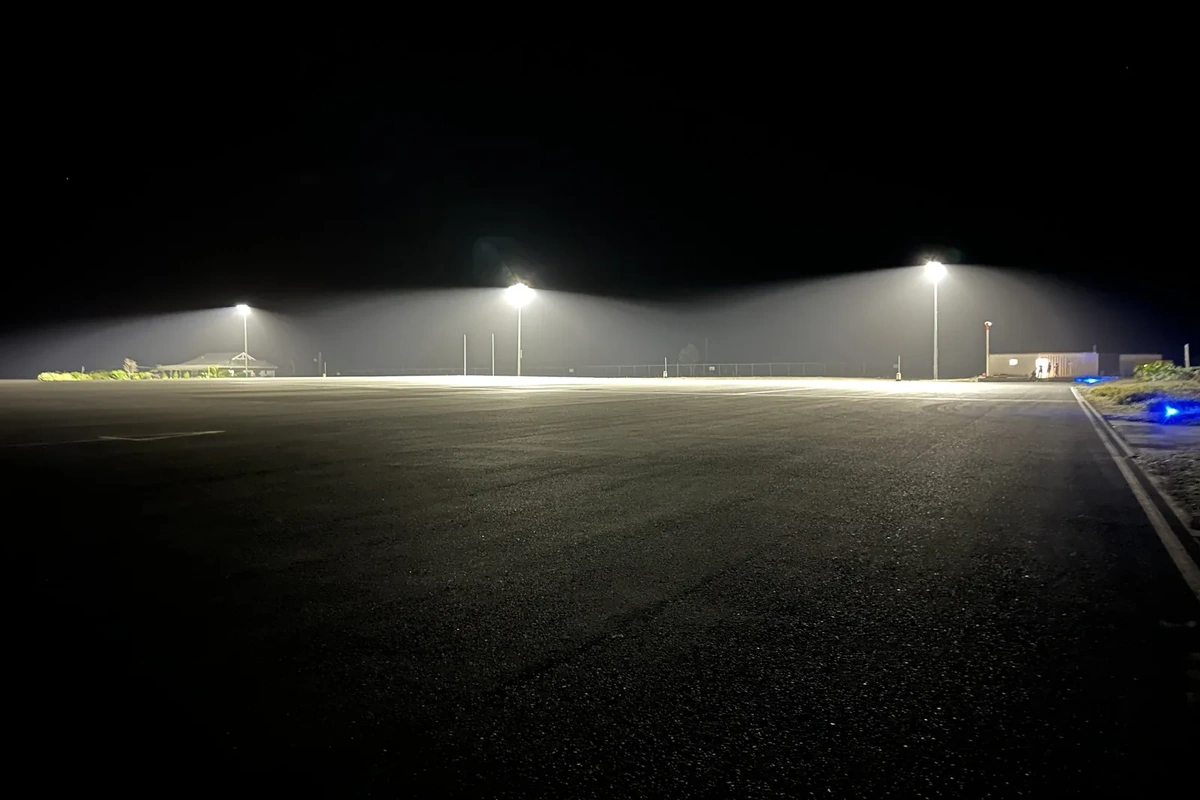
Burton–Nibbs International Airport opened in October 2024 with runway lighting in place. Apron lighting was funded as a later phase, and in 2026 Aviation Renewables supplied and installed a Musco Light-Structure System with Total Light Control (TLC) for LED — LED apron lighting structurally certified to 191 mph (307 km/h) and covered for a decade with no maintenance cost.
On an island rebuilding after Hurricane Irma, the specification was straightforward: lighting that would not have to be replaced after the next storm.
Project Snapshot
| Location | Codrington, Barbuda, Antigua and Barbuda |
|---|---|
| Client | Burton–Nibbs International Airport (IATA: BBQ) |
| Application | LED Apron Floodlighting |
| Equipment | Musco Light-Structure System with Total Light Control (TLC) for LED |
| Airport opened | October 2024 |
| Apron Lighting Completed | 2026 |
| Wind Rating | 191 mph / 307 km/h — Category 5 |
| Poles | 3 × 15.2 m (50 ft) galvanized steel |
| Luminaires | 10 × TLC-LED 550, factory-aimed |
| Maintenance Cost | $0 for 10 years |
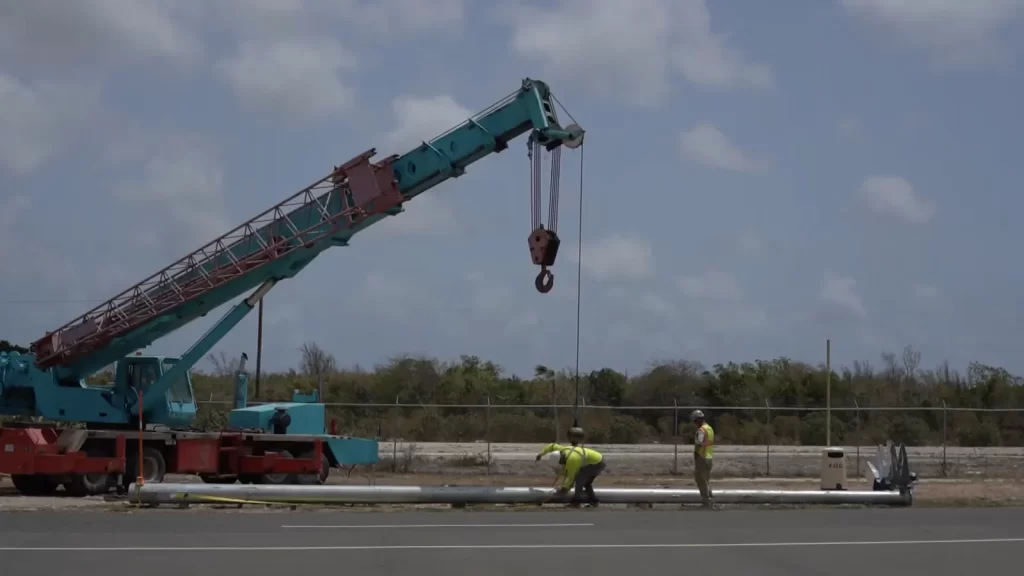
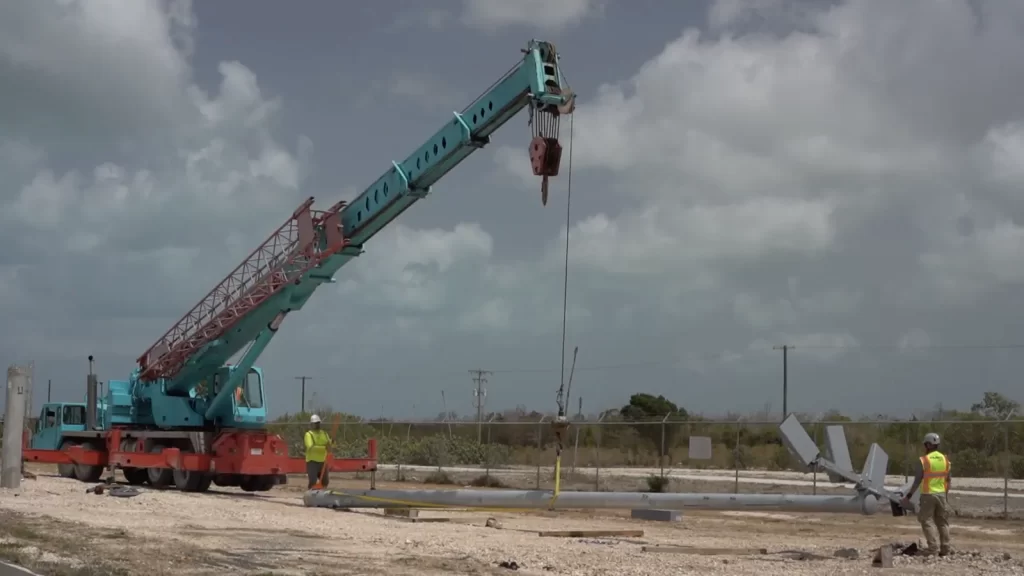
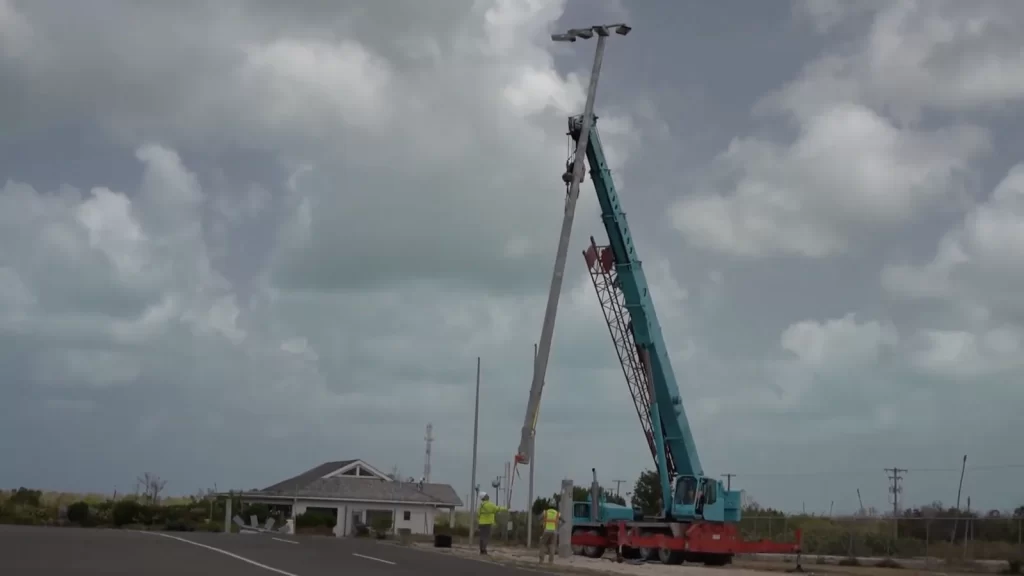
Watch the installation — a 15.2 m pole raised onto its precast base on an operational apron (33 seconds).
The Challenge: Apron Lighting as a Later Phase, on a Hurricane-Exposed Airfield
In September 2017, Hurricane Irma, one of the most powerful Atlantic storms on record, struck Barbuda directly, severely damaging the island’s original airport along with much of its infrastructure. The old airfield’s short runway suited only small STOL aircraft and could not meet the island’s long-term needs.
Antigua and Barbuda undertook a full rebuild: Burton–Nibbs International Airport (BBQ), a roughly US$55 million project that opened in October 2024 and replaced the original facility entirely.
By 2026, when apron lighting funding came through, the airport had been in service for two years. That shaped three constraints:
- Survivability well beyond code. The system had to withstand sustained Category 5 winds of 191 mph (307 km/h) or greater — not simply satisfy minimum code requirements.
- No existing infrastructure. The apron had never been lit. There were no poles, bases, or feeds to reuse — every component had to be engineered and installed from scratch, on an airfield already in service.
- Minimal on-site technical resources. A small island facility cannot support a maintenance-heavy lighting system. Long-term upkeep had to be close to zero.
The Solution: A Factory-Aimed LED Apron Lighting System
Aviation Renewables supplied a complete Musco Light-Structure System with Total Light Control (TLC) for LED technology across three new pole locations on the apron.
The galvanized steel poles and precast bases are engineered to withstand Category 5 winds — directly addressing the Barbuda community’s top concern about any new airport infrastructure on the island. The full system was factory-built, factory-wired, and pre-aimed before it ever reached the site. That cut on-site labour and guaranteed the apron hit its target light levels on the first night rather than after weeks of adjustment.
System Supplied
- (3) 15.2 m (50 ft) galvanized steel poles
- Rated to 191 mph (307 km/h) — structurally certified for full Category 5 hurricane winds
- (3) precast concrete bases with integrated lightning grounding
- Factory-wired poletop luminaire assemblies with (10) TLC-LED 550 factory-aimed luminaires
- Factory-wired and tested remote electrical component enclosures with pole-length wire harnesses
- (1) Lighting Contactor Cabinet with photocell and pushbutton high/low intensity control, UL Listed as a complete system
- Musco Constant 10™ product assurance — materials and on-site labour covered for 10 years
Outcomes: Safe Night Operations from the First Night
With the new apron lighting system in place, Burton–Nibbs International Airport can support safe, reliable nighttime aircraft handling from the system’s first night in service — no phased commissioning, no interim temporary lighting, no weeks of field adjustment.
The Category 5 hurricane-rated, factory-aimed design gives both the airport and the Barbuda community confidence that critical apron infrastructure will withstand future storms.
The Constant 10™ warranty eliminates 100% of maintenance costs for 10 years, covering both materials and on-site labour.
Why Hurricane-Rated Apron Lighting Matters Beyond the Caribbean
The engineering problem Barbuda faced is not unique to small island airports. Airports along the US Gulf Coast, Florida, Hawaii, and Atlantic Canada specify apron floodlighting for far harsher conditions than inland sites.
Three lessons transfer directly:
- Specify the wind rating, not just the fixture. Apron lighting performance is a whole-system question — poles, bases, anchorage, and luminaire mounting all have to carry the same load case. A high-efficacy luminaire on an under-rated pole is a single point of failure.
- Factory-aiming protects your photometric design. Field-aimed floodlights drift from the design as crews adjust them. Pre-aimed assemblies mean the illuminance and uniformity you specified are what the apron actually gets.
- Price the ten-year cost, not the purchase order. Apron luminaires sit 15 metres up. Every relamp or driver replacement is a lift, a crew, and an apron closure — disruptions that are far more expensive once the airfield is operational than they would have been during construction. Warranty scope that includes labour usually outweighs a lower unit price.
Apron Lighting as a Funded Phase: Delivering to Airfields Already in Service
Most airports specifying apron lighting are not building from scratch. They are operating already, working through a capital plan, and adding or upgrading apron floodlighting in a phase of its own — exactly the situation at Burton–Nibbs.
That makes factory-built, pre-aimed assemblies more valuable, not less. Shorter time on site means less disruption to an operational airfield, and a system that performs to its photometric design on the first night rather than after weeks of adjustment. The same logic applied when we delivered LED apron lighting to a West African airport, where skilled installation labour and lifting equipment were hardest to source.
Can Apron Lighting Be Engineered for Hurricane-Force Winds?
Yes. At Burton–Nibbs International Airport, the poles, precast bases, and luminaire assemblies were structurally certified to 191 mph (307 km/h), covering full Category 5 conditions — the full load case, not the luminaire alone.
Where Aviation Renewables Works
Since 2008, Aviation Renewables has delivered turnkey airfield and helipad lighting projects on all seven continents — hundreds of installations across North America, the Caribbean, South America, Europe, Africa, Asia, and Antarctica. Our installed systems operate reliably under extreme conditions and temperatures.
Our OEM-certified project teams handle design, installation, training, and commissioning in compliance with ICAO, FAA, and national civil aviation authority requirements. Barbuda is one project among many; the same capability is available to airport operators across the United States and Canada.
Planning Apron Lighting for a New Build, an Expansion, or an HID Retrofit?
Talk to our team about a photometric design and budget for your apron.
arc@aviationrenewables.com
+1 (250) 590-1272
There’s more detail than fits on a page. Download the full LED apron lighting Project Report (PDF, 3 pages) for the complete specification, site photos, and system schedule.
Sorry, the comment form is closed at this time.